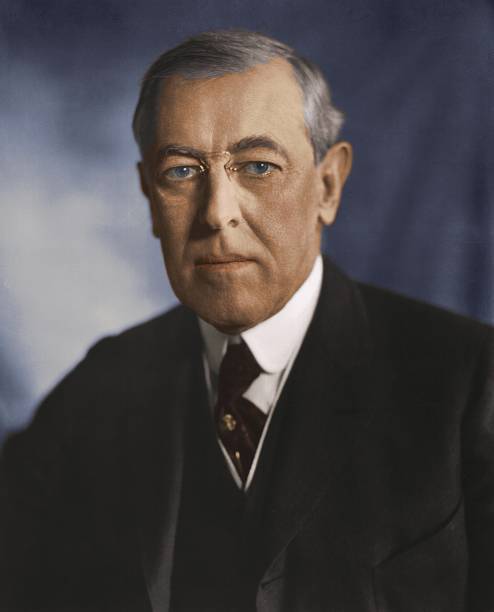
Woodrow Wilson
Thomas Woodrow Wilson was an American political scientist, historian, educator, statesman, and the 28th President of the United States. Born on December 28, 1856, in Staunton, Virginia, Wilson is widely regarded as the principal architect of Liberal Internationalism and one of the founding figures of modern International Relations. His vision of an international order based on law, diplomacy, collective security, and international institutions profoundly influenced twentieth-century global politics.
Wilson attended Davidson College before transferring to Princeton University, where he earned a Bachelor of Arts in 1879. After studying law at the University of Virginia, he pursued graduate studies at Johns Hopkins University, receiving a Ph.D. in History and Political Science in 1886. He later taught at Bryn Mawr College, Wesleyan University, and Princeton University, becoming President of Princeton in 1902, where he implemented significant educational reforms.
Before entering politics, Wilson established himself as a respected scholar through works including Congressional Government (1885), The State: Elements of Historical and Practical Politics (1889), Constitutional Government in the United States (1908), and The New Freedom (1913). His most influential contribution to International Relations came in 1918 with the Fourteen Points Address, which proposed a new framework for achieving lasting international peace.
Wilson served as Governor of New Jersey before being elected President of the United States in 1912, serving two terms from 1913 to 1921. Following the First World War, he championed an international order founded upon open diplomacy, collective security, national self-determination, and the creation of the League of Nations. These principles became the foundation of Liberal Internationalism and inspired many of the institutions and norms that shaped the modern international system.
Wilson’s thought is closely associated with the concepts of Collective Security, Liberal Internationalism, National Self-Determination, International Organization, Moral Diplomacy, Peace Through Law, Open Diplomacy, and the Rules-Based International Order. His ideas offered a direct alternative to traditional balance-of-power politics by emphasizing cooperation, international law, and multilateral institutions as the primary means of preserving peace.
Awarded the Nobel Peace Prize in 1919 for his efforts to establish the League of Nations, Wilson remains one of the most influential—and debated—figures in modern political thought. Although his international vision transformed the study and practice of International Relations, his legacy is also marked by criticism of his domestic racial policies and wartime restrictions on civil liberties.
Woodrow Wilson died on February 3, 1924, in Washington, D.C., at the age of 67. His writings and political vision continue to shape debates on international cooperation, global governance, and the pursuit of a stable international order.

